

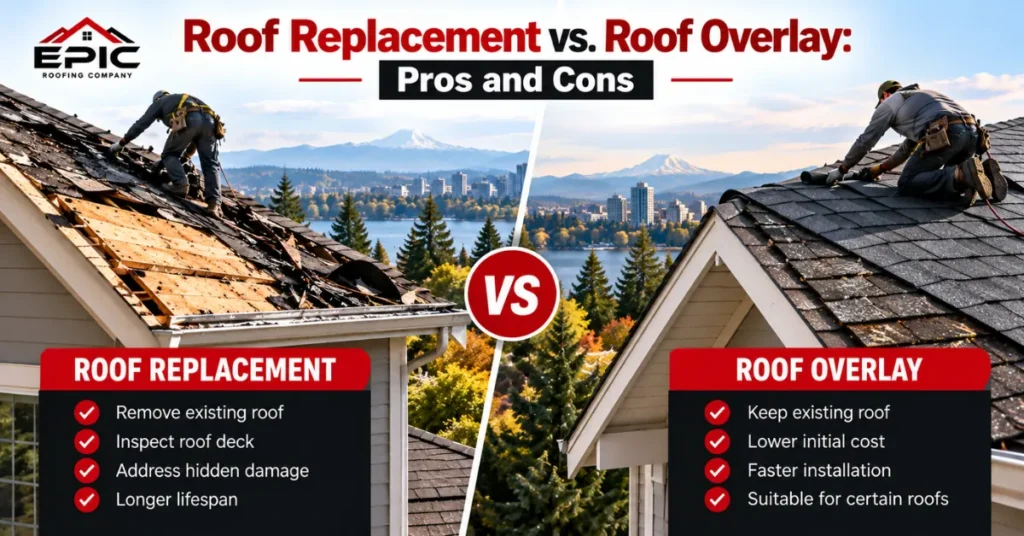
When an existing roof starts showing signs of wear, homeowners often face an important decision: should you replace the roof completely, or install new roofing over the existing layer?
A roof overlay, also called a roof recover or reroofing in some contexts, can avoid the full tear-off process. A roof replacement removes the existing roof covering and installs a new roofing system from the roof deck upward. The right approach depends on the existing roof’s condition, number of existing layers, material, local requirements, and whether there are problems underneath the visible roofing.
For Seattle-area homes, this decision deserves particular attention because a new roof covering needs to perform through prolonged wet weather. Seattle’s building code also places specific conditions on when a roof recover is permitted. For example, a recover is not permitted when the existing roof is water-soaked or too deteriorated to support the new roofing, or when there are already two or more applications of roof covering.
This guide explains the pros and cons of roof replacement vs. roof overlay, when each option may be appropriate, and what homeowners should consider before making a decision.
What Is the Difference Between Roof Replacement and Roof Overlay?
The main difference is what happens to the existing roofing.
Roof replacement involves removing the existing roof-covering layers, typically exposing the roof deck so the roofing contractor can inspect the underlying structure before installing the new system. Seattle’s building code defines roof replacement as removal of existing roof-covering layers down to the roof deck, subject to a limited exception for certain adhered ice-barrier membranes.
Roof overlay, or roof recover, involves installing a new roof covering over an existing roof covering when the existing system meets the applicable requirements.
The distinction matters because the visible roofing material does not tell the entire story. A roof may look worn from the outside while also having hidden moisture damage, deteriorated decking, inadequate flashing, or other problems underneath.
Roof Replacement vs. Roof Overlay at a Glance
| Factor | Roof Overlay | Full Roof Replacement |
|---|---|---|
| Existing roof removed | Usually no | Yes |
| Roof deck exposed | Usually no | Yes |
| Hidden damage easier to identify | Limited | Yes |
| Installation time | Often shorter | Often longer |
| Initial labor | Often lower | Usually higher |
| Existing roofing layers | Remain | Removed |
| Added roof weight | Must be considered | Existing layers removed |
| Long-term inspection opportunity | Limited | Extensive |
| Suitable for damaged roof deck | No | Yes |
| Best suited to | Suitable existing roof | Roofs needing comprehensive renewal |
The table is a general comparison. The actual suitability of an overlay depends on the existing roofing system, manufacturer requirements, building code, roof condition, and the property’s construction.
What Is a Roof Overlay?
A roof overlay places a new roofing material over an existing roof covering rather than removing the existing covering first.
The approach can sometimes be used when the existing roof is in sufficiently good condition and the new roofing system is approved for installation over it.
Seattle’s current building-code provisions allow roof recover under specified circumstances, including when the new covering is installed according to the manufacturer’s approved instructions. Certain separate roofing systems, such as some standing-seam metal systems designed to transfer loads directly to the building structure, can also be installed without removing the existing roof covering.
However, an overlay is not simply a shortcut that can be used on any roof.
The existing roof must be suitable as a base for the new system.
What Is a Full Roof Replacement?
A full roof replacement removes the existing roof-covering layers before the new roofing system is installed.
One major advantage is that the contractor can inspect the roof deck and underlying areas after the old roofing has been removed.
This creates an opportunity to identify problems that may not be visible during a surface-level inspection, such as:
- Rotting roof decking
- Water damage
- Deteriorated underlayment
- Damaged flashing
- Improper previous repairs
- Moisture intrusion
- Structural concerns
- Problems around roof penetrations
The roofing contractor can then address appropriate underlying issues before installing the new roof.
For homeowners already dealing with recurring leaks or widespread deterioration, this additional visibility can be particularly important.
Roof Overlay Pros and Cons
A roof overlay can make sense for certain roofs, but homeowners should understand both sides before choosing this approach.
Potential Advantages of a Roof Overlay
Lower Initial Labor Requirements
Because the existing roof covering remains in place, the contractor may spend less time on tear-off and disposal.
That can reduce some labor and disposal requirements compared with a complete tear-off.
However, an overlay should not be selected solely because it appears cheaper. The existing roof must first be suitable for the installation.
Faster Installation
Removing an existing roof takes additional time. When an overlay is permitted and appropriate, skipping the tear-off can shorten the installation process.
This may reduce the amount of time the property is exposed to an active roofing project.
Less Tear-Off Debris
A full replacement produces old roofing materials that need to be removed and disposed of. An overlay leaves the existing covering in place, reducing the amount of tear-off material generated by the project.
An Additional Roofing Layer
A new roof covering provides another protective surface over the existing roof.
But the benefit depends heavily on the condition of the existing roof. A new layer does not correct problems underneath it.
Potential Disadvantages of a Roof Overlay
Hidden Problems Remain Hidden
This is one of the most important limitations.
If the existing roof has concealed moisture damage, deteriorated decking, or other problems beneath the surface, installing a new layer does not automatically correct them.
The new roof may cover the visible symptoms while the underlying issue remains.
Existing Roof Adds Weight
An additional roofing layer adds material to the building.
Seattle’s code requires structural roof components to be capable of supporting the roof-covering system and the material and equipment loads encountered during installation.
A contractor should therefore consider the existing roof assembly and structural implications rather than treating an overlay as a purely cosmetic upgrade.
Existing Defects Can Affect the New Roof
If the existing roof is significantly uneven, deteriorated, or otherwise unsuitable as a base, installing another layer can create installation and performance problems.
A new roof covering does not automatically make an old roof deck or deteriorated substrate structurally sound.
Limited Opportunity to Rebuild the Roofing System
A complete replacement provides an opportunity to inspect and renew components from the roof deck upward.
An overlay provides much less visibility into those layers.
Not Every Roof Qualifies
Seattle’s code specifically restricts roof recover in certain situations. A recover is not permitted where the existing roof is water-soaked or deteriorated to the point that it cannot serve as an adequate base. It is also not permitted where the existing roof has two or more applications of roof covering.
Roof Replacement Pros and Cons
A full replacement is a more extensive roofing project, but it provides benefits that an overlay cannot always provide.
Potential Advantages of Roof Replacement
The Existing Roofing Is Removed
Removing the old roof gives the contractor access to the roof deck and underlying roofing assembly.
This makes it possible to identify conditions that could otherwise remain hidden.
Hidden Damage Can Be Addressed
If damaged decking, deteriorated flashing, or other underlying problems are discovered during tear-off, they can be evaluated and addressed as part of the project.
This is particularly important when a roof has experienced repeated leaks.
New Roofing Starts With a Clean Base
A full replacement allows the new roofing system to be installed over the prepared substrate according to the applicable installation requirements.
That can make it easier to establish a complete roofing assembly rather than building on top of an aging covering.
Better Opportunity to Correct Previous Problems
Older roofs sometimes contain previous repairs, incompatible materials, damaged flashing, poor drainage details, or other installation issues.
A complete replacement provides an opportunity to correct these conditions instead of simply covering them.
Easier to Evaluate Roof Condition
Once the old roofing is removed, the contractor has a much clearer view of the roof’s actual condition.
That can be valuable when deciding whether sections of decking, flashing, or other components require attention.
Potential Disadvantages of Roof Replacement
Higher Upfront Cost
A full replacement generally involves more labor and materials than simply installing another approved layer over an existing roof.
Costs can include:
- Tear-off
- Disposal
- New roofing materials
- Underlayment
- Flashing
- Roof-deck repairs
- Ventilation work
- Labor
- Permitting where applicable
The final price depends heavily on the roof’s size, design, material, accessibility, condition, and project requirements.
For Seattle homeowners, see our guide to roof replacement cost in Seattle for additional cost-planning information.
Longer Installation Process
A complete tear-off adds work to the project.
If hidden damage is discovered, the schedule can also change because the contractor may need to repair the substrate before continuing.
More Construction Debris
Removing the existing roofing produces more waste than an overlay.
Proper disposal and site cleanup therefore become a larger part of the project.
When Is a Roof Overlay a Suitable Option?
A roof overlay may be considered when the existing roof is structurally and functionally suitable to serve as a base for the new roofing system.
Before choosing an overlay, a contractor should evaluate:
- Existing roofing material
- Number of existing roof layers
- Roof condition
- Signs of water intrusion
- Roof-deck condition where it can be assessed
- Roof slope
- Manufacturer requirements
- Existing flashing
- Ventilation
- Structural loading
- Local building requirements
The important point is that an overlay should be based on roof condition, not simply the desire to avoid tear-off.
A roof with one relatively sound existing layer may present a very different situation from a roof with multiple layers, widespread deterioration, or recurring leaks.
When Should You Choose Full Roof Replacement?
Full replacement becomes more relevant when the existing roofing system has widespread deterioration or when the condition underneath the visible surface needs to be evaluated.
Common situations include:
Extensive Roof Damage
If damage is spread across a large portion of the roof, installing another layer may not address the underlying problems.
Repeated Leaks
Recurring leaks can indicate that the roofing system has reached a point where isolated repairs are no longer addressing the overall condition.
Deteriorated Roof Deck
If the substrate is damaged or unsuitable, the new roofing needs an appropriate base.
Multiple Existing Roof Layers
Seattle’s code does not permit a roof recover when the existing roof has two or more applications of roof covering.
Major Flashing Problems
Flashing is a critical part of roof waterproofing. A complete replacement provides an opportunity to reconstruct flashing in accordance with applicable manufacturer instructions and code requirements.
End-of-Service-Life Roofing
If an older roof has widespread aging rather than a few isolated defects, a complete replacement may be considered instead of adding another layer.
Can You Put New Shingles Over an Existing Roof?
Sometimes, but not automatically.
Whether new shingles can be installed over an existing roof depends on the existing roofing system, its condition, the number of existing layers, manufacturer requirements, and applicable building requirements.
Seattle’s code permits roof recover in specified circumstances but prohibits it when the existing roof is water-soaked or too deteriorated to serve as an adequate base. It also prohibits a recover where there are already two or more applications of roof covering.
So the answer is not simply “yes” or “no.”
The existing roof should be evaluated before deciding whether another layer is appropriate.
Does a Roof Overlay Last as Long as a Replacement?
The lifespan of either approach depends on many variables, including roofing material, installation quality, ventilation, weather exposure, maintenance, and the condition of the existing roof.
An overlay does not automatically have the same performance characteristics as a complete replacement because the existing roofing remains underneath it.
If the old roof has underlying problems, those conditions may continue to affect the overall roofing system.
A complete replacement gives the contractor an opportunity to remove the existing roof, inspect the substrate, address appropriate defects, and install a new roofing assembly.
The important question is therefore not simply “How long will an overlay last?” but “What condition is the existing roofing system in, and is it an appropriate base for another roof covering?“
Roof Replacement vs. Roof Overlay: Cost Considerations
Cost is naturally one of the biggest reasons homeowners consider an overlay.
An overlay can potentially reduce certain project costs because the existing roof covering does not have to be removed and disposed of.
A replacement generally involves additional labor and disposal because the existing roof is removed.
However, comparing only the initial installation price can leave out important considerations.
For example, suppose an existing roof has hidden moisture damage. An overlay might leave that condition in place, while a replacement creates an opportunity to discover and address it.
That is why a roofing estimate should explain:
- Existing roof condition
- Number of roof layers
- Proposed roofing system
- Tear-off requirements
- Underlayment
- Flashing
- Roof-deck assumptions
- Ventilation
- Cleanup and disposal
- Warranty
- Potential additional work
A detailed estimate makes it easier to compare two proposals based on what is actually included rather than comparing only the headline price.
How Existing Roof Damage Affects the Decision
The condition of the existing roof is one of the most important factors in the decision.
Consider a roof with:
Localized damage:
A repair may be appropriate if the overall roof remains in good condition.
Widespread surface aging:
A replacement may deserve consideration depending on the roof’s age and condition.
Hidden moisture concerns:
A complete replacement can provide better access to the underlying assembly.
Multiple existing layers:
An overlay may not be permitted under applicable code requirements.
Damaged roof decking:
The underlying substrate needs to be addressed rather than simply covered.
If you are unsure whether your roof needs repair or replacement, a professional inspection can help determine the condition of the entire system. You can learn more about roof inspections in Seattle.
Seattle Roofing Considerations
Seattle homeowners should also consider local requirements before starting a reroofing project.
Seattle’s current SDCI guidance says a re-roof permit is required for certain commercial and multifamily work, including replacing roofing materials on commercial and multifamily projects and certain repairs or replacement work involving more than 500 square feet. The city’s guidance also states that certain one- and two-family residential roof replacement work does not require a permit when it does not change the building envelope, subject to the stated conditions.
Seattle also distinguishes between its Building Code, Existing Building Code, and Residential Code depending on the type of property and project.
Because permit requirements can depend on the property and scope of work, homeowners should verify current requirements with Seattle Department of Construction and Inspections before beginning a project.
For roofing work outside Seattle, requirements may differ by jurisdiction.
Questions to Ask Before Choosing an Overlay or Replacement
Before signing a roofing contract, ask the contractor:
How many roofing layers are currently on the home?
The number of existing layers can affect whether an overlay is permitted or appropriate.
What condition is the existing roof in?
Ask for specific findings rather than simply being told that the roof is “old.”
Is there evidence of moisture or roof-deck damage?
This can significantly affect whether a new covering should be installed over the existing system.
Why are you recommending an overlay or replacement?
A professional recommendation should be based on the roof’s condition and project requirements.
What happens if damaged decking is found?
Make sure the estimate explains how unexpected substrate repairs will be handled.
What roofing materials are being proposed?
Ask about the product, installation requirements, warranty, and compatibility with the existing roof.
Are flashing and roof penetrations included?
A new roof should not leave deteriorated critical components unaddressed.
What permits are required?
Permit requirements vary according to location, building type, and scope of work.
What warranty is included?
Understand both the material warranty and the contractor’s workmanship coverage.
Can I see the existing roof condition before the project begins?
Photos can make it easier to understand why a particular approach is being recommended.
Roof Overlay vs. Roof Replacement: Which One Fits Your Roof?
There is no universal answer for every property.
An overlay may be appropriate when the existing roof is in suitable condition, the roofing system permits it, and the applicable code requirements are satisfied.
A full replacement provides a more comprehensive opportunity to remove old roofing, inspect the roof deck, correct underlying problems, and install a new roofing system.
The key is to evaluate the entire roofing assembly, not just the visible shingles.
For homeowners dealing with an aging or damaged roof, roof repair services in Seattle may be appropriate when the issue is localized, while roof replacement services in Seattle can address roofs that require a more comprehensive renewal.
Frequently Asked Questions
Is a roof overlay cheaper than a full replacement?
An overlay can have lower upfront labor and disposal requirements because the existing roof covering remains in place. However, cost depends on the roofing system, roof condition, materials, and project requirements.
Is roof overlay a good idea?
It can be appropriate for some roofs when the existing roofing is suitable as a base and the installation complies with applicable requirements. It is not appropriate for every roof.
Can you put a second layer of shingles over an existing roof?
In some situations, yes. However, applicable building requirements, manufacturer instructions, existing roof condition, and the number of existing layers all need to be considered. Seattle’s code restricts roof recover in certain conditions, including roofs with two or more existing applications.
Does an overlay hide roof damage?
It can leave concealed problems underneath the new roofing. If moisture intrusion, deteriorated decking, or other underlying problems are suspected, a complete replacement may provide better access for evaluation.
How many layers of roofing can a house have?
The answer depends on applicable building requirements and the roofing system. In Seattle, a roof recover is not permitted where the existing roof has two or more applications of any type of roof covering.
Should I replace my roof or overlay it?
The decision should be based on the existing roof’s condition, material, number of layers, underlying substrate, manufacturer requirements, and applicable local requirements.
Does a roof overlay affect roof weight?
Yes. Adding another roofing layer adds material weight. Seattle’s code requires structural roof components to be capable of supporting the roof-covering system and associated installation loads.
Do I need a permit for roof replacement in Seattle?
Permit requirements depend on the property type and scope of work. Seattle SDCI provides separate guidance for residential, commercial, and multifamily projects, so homeowners should verify the requirements applicable to their specific project.
Conclusion
he decision between roof replacement vs. roof overlay should be based on the condition of the existing roofing system, not simply the upfront installation price.
A roof overlay can reduce tear-off work and may be suitable for certain roofs that meet the necessary conditions. A full replacement requires more work but provides access to the roof deck and creates an opportunity to address hidden deterioration before installing the new system.
For Seattle properties, applicable building requirements also matter. Current Seattle code provisions place specific limits on roof recover, including restrictions involving deteriorated or water-soaked roofs and roofs with two or more existing roof-covering applications.
Before choosing either option, have the existing roof evaluated, understand what is included in the estimate, and make sure the proposed installation is appropriate for the building and roofing material.
A good roofing decision starts with understanding what is underneath the roof—not just what is visible from the ground.