
If you’re considering a metal roof for your home or commercial property, two systems you’ll likely encounter are standing seam metal roofing and corrugated metal roofing. Both can provide long-term durability, but they differ in how the panels are fastened, installed, maintained, and designed to manage weather exposure.
For homeowners in Seattle and surrounding areas, the choice also needs to account for frequent rain, moisture, wind, roof pitch, drainage, and long-term maintenance. The right system isn’t necessarily the most expensive one; it is the system that fits your property, budget, roof design, and long-term goals.
This guide compares standing seam vs. corrugated metal roofing across cost, lifespan, installation, maintenance, appearance, durability, and suitability for the Pacific Northwest.
Standing Seam vs. Corrugated Metal Roofing at a Glance
| Feature | Standing Seam Metal Roofing | Corrugated Metal Roofing |
|---|---|---|
| Fastener System | Generally concealed | Typically exposed |
| Appearance | Clean, modern panel lines | Ribbed, traditional appearance |
| Initial Cost | Generally higher | Generally lower |
| Maintenance | Fewer exposed fasteners to monitor | Fasteners and washers require periodic attention |
| Durability | High when properly specified and installed | High when properly specified and maintained |
| Lifespan | Long-term | Long-term with proper maintenance |
| Installation | Requires careful system-specific installation | Generally simpler panel installation |
| Seattle Climate | Well suited when properly designed | Can perform well with proper installation and maintenance |
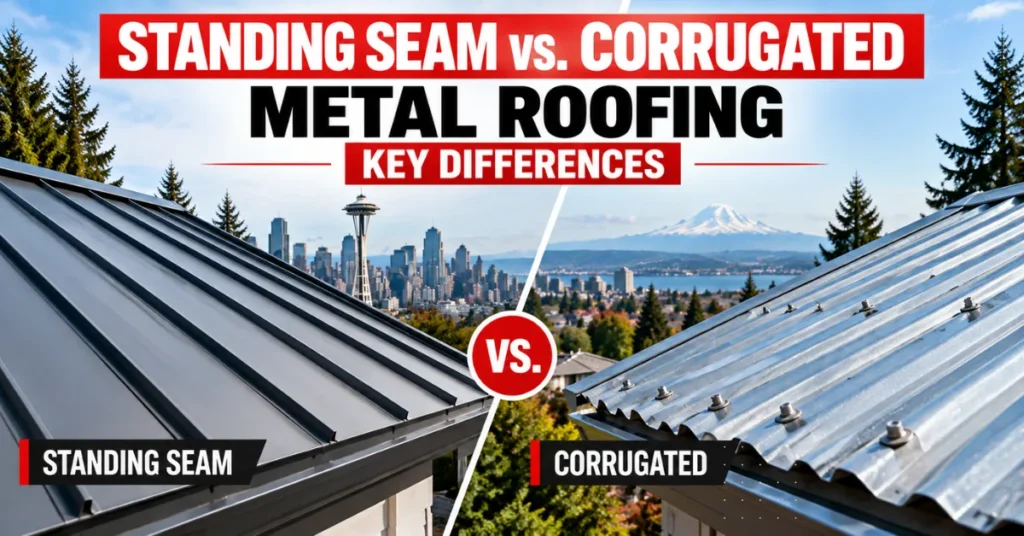
The biggest difference is the fastening system. Standing seam panels generally use concealed fasteners, while many corrugated systems use exposed screws. That difference affects appearance, maintenance, installation, and how the roofing system handles movement and weather over time.
What Is Standing Seam Metal Roofing?
Standing seam metal roofing uses long metal panels connected by raised vertical seams. The panels are typically attached with clips or other fastening methods that keep the primary fasteners concealed beneath or within the seam system.
This design creates the clean, continuous appearance commonly associated with modern standing seam metal roofing. It can be used on residential and commercial buildings and is available in various metals, finishes, profiles, and colors.
How Standing Seam Roofing Works
Instead of placing exposed screws through the face of every panel, a standing seam system generally uses concealed fastening components. The raised seams connect adjacent panels while allowing the system to accommodate normal expansion and contraction.
This is particularly important with metal roofing because panels respond to changes in temperature. A properly designed and installed system needs to account for that movement rather than restricting the panels unnecessarily.
Benefits of Standing Seam Roofing
Standing seam systems are often selected for their clean appearance and long-term performance. With fewer exposed fasteners, there are fewer visible screw heads and washers across the roof surface.
Other potential advantages include strong weather resistance, a modern appearance, long service life, and relatively straightforward visual inspection of the panel and seam system.
For a homeowner planning a long-term roofing investment, a standing seam roof can be an attractive option when the roof design, budget, and installation requirements align.
What Is Corrugated Metal Roofing?
Corrugated metal roofing uses panels formed with repeating ribs or waves that increase the panel’s structural strength. Many corrugated systems are installed with exposed fasteners that pass through the panels and attach them to the roof structure.
The familiar ribbed appearance makes corrugated metal roofing suitable for a range of residential, agricultural, and commercial applications. Different panel profiles, gauges, coatings, and colors are available depending on the manufacturer and project requirements.
How Corrugated Metal Roofing Works
Corrugated panels overlap at their edges, with fasteners securing the panels to the underlying structure. Proper installation requires attention to panel alignment, fastener placement, washers, overlaps, flashing, and sealants.
Because the fasteners are often exposed, their condition is an important part of long-term maintenance. Loose or deteriorated fasteners and washers can create potential water-entry points if they are not addressed.
Benefits of Corrugated Metal Roofing
One of the biggest attractions of corrugated systems is their relatively simple panel design. Depending on the material and project, they can also have a lower initial cost than a comparable standing seam system.
Corrugated panels provide a distinctive ribbed appearance and can be available in a wide range of finishes. When correctly installed and maintained, a corrugated metal roof can provide durable long-term protection.
What Is the Difference Between Standing Seam and Corrugated Metal Roofing?
The main difference between these systems is how the panels are connected and fastened to the roof.
Standing seam roofing generally uses concealed fasteners, while corrugated metal roofing commonly uses exposed fasteners. This creates differences in appearance, maintenance, installation, and repair considerations.
Fastener Design
A standing seam system keeps the primary attachment hardware concealed within the panel or seam assembly. Corrugated systems commonly have screw heads visible across the panel surface.
Exposed fasteners are not automatically a problem. They simply require appropriate installation and periodic inspection because screws, washers, and surrounding areas can deteriorate over time.
Panel Seams
Standing seam panels have raised vertical seams that connect adjacent panels. Corrugated panels use overlapping edges and their formed ribs to create the roofing surface.
The two systems therefore have different visual characteristics and installation requirements.
Installation
Standing seam systems typically require more specialized installation because the panels, clips, seams, and movement requirements need to work together correctly.
Corrugated systems can have a simpler installation process, but that does not mean installation quality is less important. Correct fastening, panel overlap, flashing, underlayment, and drainage details remain essential.
Maintenance
Maintenance is another important distinction. Standing seam systems have fewer exposed fasteners on the roof surface, while corrugated systems require closer attention to exposed screws, washers, sealants, and panel connections.
For either system, gutters, flashing, roof penetrations, drainage, and surrounding vegetation should also be maintained.
Appearance
Standing seam generally provides a cleaner and more contemporary appearance, with long vertical lines and minimal visible hardware.
Corrugated roofing has a more pronounced ribbed appearance that can work well with traditional, industrial, agricultural, and certain residential designs.
Standing Seam vs. Corrugated Metal Roof Cost
The cost difference between standing seam vs. corrugated metal roof depends on much more than the panels themselves.
Project pricing can be influenced by:
- Roof size
- Roof pitch
- Roof complexity
- Existing roofing removal
- Underlayment
- Roof deck condition
- Flashing
- Penetrations
- Material type and gauge
- Coating and finish
- Labor
- Accessibility
- Installation requirements
Standing seam generally has a higher upfront cost because the system can require specialized panels, clips, fastening components, and installation.
Corrugated metal roofing can have a lower initial cost depending on the product and installation method. However, homeowners should compare the complete roofing system rather than choosing strictly on the initial panel price.
For Seattle homeowners, it is useful to compare the full scope of each proposal, including underlayment, flashing, ventilation, tear-off, disposal, and installation.
Which Metal Roof Lasts Longer?
Both systems can provide long-term performance when the appropriate materials are used and the installation is performed correctly. There is no single lifespan that applies to every standing seam or corrugated roof.
The actual service life depends on factors such as:
- Metal type
- Coating quality
- Installation quality
- Fastener quality
- Moisture exposure
- Corrosion
- Roof pitch
- Drainage
- Maintenance
- Local weather conditions
Standing Seam Roof Lifespan
A properly installed standing seam system can provide long-term service because the panel system has fewer exposed fasteners and is designed to accommodate normal metal movement.
However, the quality of the installation remains critical. Poorly installed seams, flashing, penetrations, or clips can undermine the performance of an otherwise high-quality roofing system.
Corrugated Metal Roof Lifespan
Corrugated metal roofs can also last for many years when quality materials are installed correctly and maintained properly. Because many systems use exposed fasteners, periodic inspection of screws, washers, sealants, and panel connections is particularly important.
Which Is Better for Seattle’s Climate?
Seattle and the surrounding Puget Sound region present a particular set of roofing conditions. Frequent rainfall, prolonged moisture exposure, wind, seasonal temperature changes, and organic growth around roofs all make water management important
That doesn’t mean one metal roofing system is automatically right for every Seattle property. Roof pitch, drainage, flashing, installation quality, material selection, and maintenance can be just as important as the panel style.
Standing Seam Roofing in Seattle
Standing seam can be a strong option for Seattle homes and commercial properties when the system is properly designed and installed. Its concealed-fastener construction and clean panel design can be particularly attractive for homeowners looking for long-term performance and a contemporary appearance.
The roof still needs proper flashing, drainage, underlayment, ventilation where appropriate, and regular inspection.
Corrugated Metal Roofing in Seattle
Corrugated metal roofing can also perform well in Seattle when the panel system is appropriate for the property and installed correctly
Because many corrugated systems use exposed fasteners, regular maintenance becomes particularly important. Fasteners, washers, sealants, panel overlaps, and flashing should be checked periodically for deterioration or potential water-entry points.
The best metal roofing for Seattle is ultimately the system that is properly matched to the building and installed with appropriate weather-management details.
Standing Seam vs. Corrugated Metal Roofing: Maintenance
Metal roofing is often promoted as low maintenance, but no roofing system should be considered maintenance-free.
Standing Seam Roof Maintenance
Standing seam maintenance generally includes checking:
- Panel seams
- Flashing
- Roof penetrations
- Gutters and drainage
- Coating condition
- Areas around chimneys and skylights
- Accumulated debris
The concealed-fastener design reduces the number of exposed screws that need to be monitored, but other roofing components can still deteriorate.
Corrugated Metal Roof Maintenance
Corrugated roofing requires attention to:
- Exposed fasteners
- Rubber washers
- Panel overlaps
- Sealants
- Flashing
- Corrosion
- Coating condition
- Gutters and drainage
A loose or deteriorated fastener does not necessarily mean the entire roof needs replacement. Addressing individual problems early can help prevent them from developing into larger water-intrusion issues.
Standing Seam vs. Corrugated Roofing: Pros and Cons
Standing Seam Pros
Standing seam roofing offers concealed fastening, a clean appearance, strong weather resistance, and long-term durability when properly installed. It can also require less attention to exposed fasteners compared with many corrugated systems.
Standing Seam Cons
The main disadvantages are generally the higher upfront cost and the need for experienced installation. Repairs can also require careful matching of the existing panel profile and system.
Corrugated Metal Roofing Pros
Corrugated roofing can provide a practical metal roofing solution with a distinctive ribbed appearance and, depending on the project, a lower initial cost. It is available in many finishes and can work across various property types.
Corrugated Metal Roofing Cons
Exposed fasteners and washers require periodic inspection and maintenance. Improper fastening, deteriorated sealants, or neglected corrosion can create potential water-entry problems.
Which Metal Roofing System Is Better for Your Seattle Home?
There is no universal winner in the standing seam or corrugated metal roof comparison.
Standing seam may be a better fit if your priorities include:
- A clean, modern appearance
- Concealed fasteners
- Long-term investment
- Reduced exposed-fastener maintenance
- A premium metal roofing system
Corrugated roofing may make more sense if you prioritize:
- Lower initial project cost
- A traditional ribbed appearance
- A simpler panel system
- A suitable property and roof design
- Willingness to maintain exposed fasteners
The condition of your existing roof should also be considered before selecting a new system. A professional assessment can help determine roof pitch, deck condition, drainage requirements, flashing needs, and whether the existing structure is suitable for the planned roofing system.
Metal Roofing for Seattle and Surrounding Areas
The same comparison applies to homeowners throughout the greater Seattle area, including Bellevue, Kirkland, Redmond, Renton, Bothell, Lynnwood, Shoreline, Sammamish, and Federal Way.
However, a metal roofing decision should be based on the individual property rather than simply the city where it is located. Roof slope, building design, existing materials, drainage, exposure, and installation access can all affect which system makes sense.
For example, a complex residential roof may require different panel and flashing details than a simple low-slope commercial building. A property surrounded by trees may also have different maintenance needs from a more exposed site.
How to Choose Between Standing Seam and Corrugated Metal Roofing
Before selecting a system, ask your roofing contractor to evaluate the complete project rather than comparing panel prices alone.
Consider:
- Existing roof condition: Determine whether the roof deck and supporting components are ready for the new system.
- Roof pitch: Confirm which metal roofing profiles are appropriate for the roof slope.
- Budget: Compare the complete installed cost rather than just material prices.
- Expected lifespan: Consider how long you plan to own the property.
- Maintenance: Understand the long-term requirements of exposed versus concealed fasteners.
- Appearance: Consider how each profile works with the home’s architecture.
- Drainage: Make sure valleys, gutters, and roof edges are properly designed.
- Flashing: Confirm how walls, chimneys, skylights, and penetrations will be handled.
- Warranty: Review both manufacturer and workmanship coverage.
- Installer experience: Choose a contractor familiar with the specific metal roofing system.
Frequently Asked Questions
Is standing seam better than corrugated metal roofing?
Neither system is automatically better for every property. Standing seam offers concealed fasteners and a clean appearance, while corrugated roofing can provide a practical metal roofing solution with a lower initial cost in some projects. The right choice depends on the roof design, budget, installation requirements, and long-term goals.
Is standing seam metal roofing more expensive than corrugated roofing?
Standing seam generally costs more upfront because of its panel design, concealed fastening system, and installation requirements. However, the complete project cost depends on the roof size, materials, complexity, labor, existing roof condition, and other installation factors.
Which metal roof is better for Seattle’s rainy climate?
Both systems can work well in Seattle when properly designed and installed. Water management, flashing, drainage, roof pitch, underlayment, material selection, and installation quality are critical factors regardless of whether you choose standing seam or corrugated roofing.
How long does standing seam metal roofing last?
A properly installed, quality standing seam system can provide long-term service, but actual lifespan varies according to the metal, coating, installation quality, weather exposure, maintenance, and other site conditions.
Does corrugated metal roofing require more maintenance?
Many corrugated systems use exposed fasteners, so screws, washers, sealants, and panel connections should be inspected periodically. This is one of the key maintenance differences compared with concealed-fastener standing seam systems.
Can you replace an existing shingle roof with metal roofing?
In some situations, metal roofing can be installed over an existing roof, but the appropriate approach depends on the existing roofing layers, local requirements, roof condition, deck condition, and selected metal roofing system. A professional assessment should be completed before deciding how the new roof will be installed.
Conclusion
Standing seam and corrugated metal roofing can both be effective roofing systems, but they serve different priorities.
Standing seam generally provides a cleaner concealed-fastener design and is often chosen for premium residential and commercial applications where long-term performance and appearance are important. Corrugated metal roofing can offer a practical alternative with a distinctive profile and potentially lower initial cost.
For Seattle homeowners, the most important factor is not simply choosing one panel style over the other. Proper installation, flashing, drainage, underlayment, material quality, and ongoing maintenance have a major impact on how any metal roofing system performs.
If you’re considering metal roofing in Seattle or surrounding areas, have the existing roof evaluated and compare complete installation proposals before making a decision.