

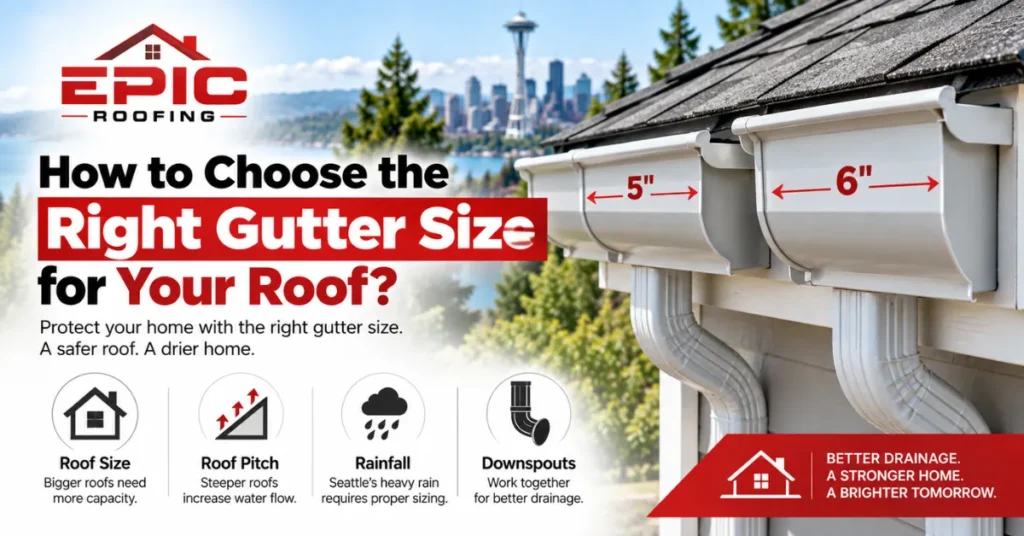
Choosing the right gutter size is more important than simply picking the most common option at the home improvement store. Gutters need to collect and move rainwater quickly enough to prevent overflow, especially during heavy rainfall.
For Seattle-area homes, that matters because roofs regularly deal with wet weather and concentrated runoff. A gutter system that is too small can overflow during stronger storms, while an oversized or poorly matched system may add unnecessary cost without solving the real drainage problem.
The right gutter size depends on several factors, including roof area, roof pitch, rainfall intensity, gutter shape, downspout size, and how much water each section of the roof sends toward a particular gutter run.
Key Points
- 5-inch and 6-inch gutters are common residential sizes.
- Roof drainage area matters more than the home’s total interior square footage.
- Steep roofs and concentrated runoff may require greater gutter capacity.
- Downspout size and placement are just as important as gutter size.
- Roof valleys can send concentrated water toward a single gutter section.
- The best system is properly sized and designed for the home’s actual drainage needs.
What Is the Standard Gutter Size for a House?
Most residential gutter systems use either 5-inch or 6-inch gutters.
A 5-inch K-style gutter is common on many standard residential roofs. A 6-inch K-style gutter provides greater water-handling capacity and is often appropriate for larger roofs, steeper roof sections, or areas where runoff is concentrated.
Common residential options include:
| Gutter Size | Typical Use |
|---|---|
| 5-inch K-style | Standard residential roof sections |
| 6-inch K-style | Larger or steeper roofs and higher runoff |
| 5-inch half-round | Traditional residential applications |
| 6-inch half-round | Larger traditional systems |
These are general guidelines rather than fixed rules. The correct size should be determined from the roof’s drainage characteristics.
Does Roof Size Determine Gutter Size?
Roof size is one of the most important factors, but it is not the only one.
A large roof generally collects more rainwater than a small roof. However, what matters for an individual gutter section is the roof area draining into that specific gutter, not necessarily the total square footage of the entire house.
For example, a home may have several roof planes. One gutter run might receive water from a relatively small roof section, while another may collect runoff from a large, steep section.
This means a contractor needs to evaluate the drainage path instead of simply saying, “This house has a 5-inch gutter.”
How Roof Pitch Affects Gutter Size?
Roof pitch changes how quickly water can reach the gutters.
A steep roof can move rainwater toward the eaves more rapidly than a low-slope roof. During a heavy storm, that can increase the amount of water reaching the gutter system over a short period.
This is one reason two roofs with similar surface areas may not require identical gutter configurations.
When evaluating gutter capacity, the roof’s slope should be considered alongside the drainage area and local rainfall conditions.
Why Seattle Rainfall Matters
Seattle homeowners need to think about gutter capacity in the context of the Pacific Northwest’s wet climate.
The issue is not merely how much rain falls over an entire year. Rainfall intensity matters because gutters have to handle water as it arrives.
A gutter system that performs adequately during light rain can still overflow when a heavier burst of rainfall sends a large amount of runoff toward one roof edge.
Homes surrounded by mature trees can also face additional maintenance demands because leaves, needles, and organic debris can restrict water flow.
For Seattle properties, choosing the gutter size should therefore be part of a broader roof drainage plan rather than a standalone product decision.
5-Inch vs. 6-Inch Gutters
The biggest residential gutter-size decision is often between 5-inch and 6-inch systems.
5-Inch Gutters
Five-inch K-style gutters are widely used on residential properties and can work well when the roof drainage area and rainfall conditions are within their capacity.
They are often suitable for:
- Smaller residential roof sections
- Typical single-family homes
- Less concentrated runoff areas
- Roofs with moderate slopes
A 5-inch system may be perfectly adequate when the drainage design is straightforward.
6-Inch Gutters
Six-inch gutters provide more capacity and can be a better choice where water volume is higher.
They may make sense for:
- Large roof areas
- Steeper roof pitches
- Large homes
- Long gutter runs
- Areas receiving concentrated runoff
- Roof configurations with higher drainage demands
Choosing 6-inch gutters does not automatically solve every drainage issue, however. Downspouts, outlet placement, gutter slope, and overall system design are equally important.
What Size Downspouts Should You Use?
Gutters and downspouts need to work together.
Installing a larger gutter but keeping too few or undersized downspouts can create a bottleneck. Water may enter the gutter successfully but fail to leave the system quickly enough.
Common residential downspout sizes include 2 × 3 inches and 3 × 4 inches for rectangular systems, although exact requirements vary with the gutter system and drainage area.
Larger roof sections may benefit from larger downspouts or additional downspouts rather than relying on one outlet to handle too much water.
How Many Downspouts Does a Roof Need?
There is no single downspout count that works for every house.
The appropriate number depends on:
- Gutter length
- Roof drainage area
- Gutter size
- Downspout size
- Roof pitch
- Where water naturally concentrates
- Where the downspouts can discharge safely
A long gutter run with only one downspout may struggle during heavy rain even if the gutter itself is large enough.
Strategically placed downspouts can improve drainage and reduce the amount of water that has to travel along the gutter before reaching an outlet.
What Happens If Gutters Are Too Small?
Undersized gutters can create several problems.
During heavy rain, water may flow over the front edge instead of entering the gutter. Depending on where the overflow occurs, this can contribute to water collecting near the home’s foundation, saturating landscaping, staining siding, or damaging exterior surfaces.
Overflow can also occur because of:
- Clogged gutters
- Incorrect gutter slope
- Too few downspouts
- Blocked downspout outlets
- Poorly positioned roof valleys
- Excessive roof runoff
This is why simply increasing gutter size isn’t always the correct fix.
What Happens If Gutters Are Too Large?
Oversizing gutters is generally less problematic than undersizing them, but bigger is not automatically better.
Larger gutters can cost more in materials and installation. They can also change the visual appearance of the home’s exterior.
More importantly, if the underlying drainage problem is caused by blocked downspouts, poor slope, or incorrect installation, simply installing a bigger gutter may fail to address the actual issue.
The goal is a properly balanced drainage system, not the largest gutter available.
Roof Valleys Can Concentrate Water
Roof valleys deserve special attention when selecting gutter capacity.
A valley directs water from two roof planes into a concentrated drainage path. When heavy rain moves through the roof valley, a significant amount of runoff may arrive at one section of gutter.
This can overwhelm an otherwise adequate gutter system if the drainage area hasn’t been accounted for.
A professional assessment should identify where valleys discharge and whether additional capacity or strategically placed downspouts are needed.
Gutters for Different Roof Types
The best gutter configuration can also depend on the type and design of the roof.
Asphalt Shingle Roofs
Standard residential asphalt shingle roofs commonly use 5-inch or 6-inch K-style gutters, depending on roof size, pitch, and runoff.
Metal Roofs
Metal roofing can shed water efficiently, particularly on steeper slopes. In some installations, water may move quickly enough that gutter placement and sizing require additional consideration.
Snow guards, roof geometry, and the way water leaves the metal panels may also influence the drainage design.
Low-Slope and Flat Roofs
Low-slope roofing systems may use different drainage approaches, particularly on commercial buildings or larger structures.
Instead of relying entirely on conventional eave gutters, some roofs use internal drains, scuppers, or other drainage systems.
For residential low-slope roofs, the appropriate solution depends on the specific roof design.
How to Choose the Right Gutter Size
A practical gutter-sizing evaluation should consider the following:
Measure the Roof Drainage Area: Determine which roof sections drain toward each gutter run.
Evaluate Roof Pitch: Steeper sections can increase runoff speed and should be considered when selecting capacity.
Look at Rainfall Intensity: The system should be designed around the amount of water it may need to handle during heavier rainfall, not only average conditions.
Select an Appropriate Gutter Size: Choose a gutter size that provides sufficient capacity without unnecessarily increasing the system’s cost.
Match the Downspouts: Make sure the downspouts can move the collected water efficiently.
Plan the Discharge Location: Water should be directed away from the home in a way that protects the foundation and surrounding property.
Do You Need 5-Inch or 6-Inch Gutters in Seattle?
For many Seattle-area homes, either 5-inch or 6-inch gutters can be appropriate depending on the roof configuration.
A straightforward residential roof with moderate drainage demands may work well with 5-inch gutters.
A larger home, steep roof, long gutter run, or roof section receiving concentrated runoff may justify 6-inch gutters.
There is no universal Seattle gutter size because homes differ substantially in roof design and drainage requirements.
When Should You Replace Your Gutters?
Gutter replacement may be appropriate when the existing system has reached the point where repairs are no longer addressing recurring problems.
Signs include:
- Frequent overflow despite cleaning
- Rust or significant corrosion
- Cracks or holes
- Sagging sections
- Detached gutters
- Repeatedly leaking joints
- Water pooling near the foundation
- Downspouts that cannot handle the runoff
- Gutters pulling away from the fascia
If the roof itself is also being replaced, it is a useful time to review the entire drainage system.
The new roofing system may change runoff patterns or expose areas where the existing gutters and downspouts are no longer adequate.
Gutter Size and Roof Replacement
Gutters are closely connected to the roof’s performance.
During a roof replacement in Seattle, the contractor can evaluate whether existing gutters properly accommodate runoff from the roof.
A roofing project is also a logical opportunity to address related drainage concerns, particularly around roof valleys, eaves, flashing, and downspout discharge points.
For homes with existing drainage problems, repairing the roof without addressing the gutter system may leave part of the water-management problem unresolved.
How to Keep Your Gutters Working Properly
Even correctly sized gutters can fail to perform when they are blocked or poorly maintained.
Seattle homeowners should pay attention to gutters when there are mature trees near the roof. Leaves, needles, moss, and other debris can restrict water movement and create localized overflow.
Regular cleaning helps maintain flow through the gutter and downspouts.
It’s also worth checking the system after periods of heavy rain. Overflow marks, water cascading over the front edge, or saturated areas around downspouts can indicate that the drainage system needs attention.
For additional roof care, see our guide to how to maintain a roof in harsh weather.
Conclusion
Choosing the right gutter size starts with understanding how much water the roof needs to drain.
For many residential homes, 5-inch and 6-inch gutters are the most common options, but the correct choice depends on the roof’s drainage area, pitch, rainfall intensity, gutter layout, and downspout capacity.
A bigger gutter is not always the answer. The entire system needs to work together so rainwater moves from the roof into the gutter, through the downspout, and safely away from the home.
For Seattle homeowners, proper sizing becomes even more important when dealing with heavy rain, mature tree coverage, complicated roof designs, or recurring overflow.